

The Services Selection Board (SSB) interview is not a conventional examination. It cannot be approached through rote memorisation or superficial preparation. Instead, it is a sustained, multi-layered assessment of an individual’s intelligence, personality, leadership potential, psychological stability, & overall suitability for commissioning as an officer in the Indian Armed Forces. A detailed understanding of the process is essential, as awareness of the assessment criteria enables candidates to prepare purposefully & effectively.
What Is the SSB & Why Does It Exist?
The Services Selection Board was established after World War II, when the Indian military recognised that academic achievement & physical fitness alone were insufficient predictors of officer quality. Drawing inspiration from the British War Office Selection Board, India adapted & refined the system, creating one of the most sophisticated officer selection processes globally. The SSB evaluates candidates based on Officer-Like Qualities, a set of 15 attributes considered essential for military leadership. These qualities include effective intelligence, reasoning ability, organisational skills, power of expression, social adaptability, cooperation, sense of responsibility, initiative, self-confidence, decision-making speed, group influence, courage, stamina, determination, & officer-like bearing. Each task over the five-day process is designed to reveal whether these qualities appear consistently across different situations & contexts.
Day One — Screening
The selection process commences immediately upon arrival. Day One begins with the objective of efficiently identifying candidates who meet the initial criteria for further assessment.
The day begins with the Officer Intelligence Rating (OIR) Test, which consists of verbal & non-verbal intelligence questions administered under strict time constraints. This assessment does not evaluate general knowledge; rather, it measures comprehension speed, pattern recognition, & the ability to process information accurately & efficiently. Candidates are then categorised into one of five intelligence levels based on their scores.
The Picture Perception & Description Test (PPDT) follows immediately. In this exercise, a hazy, ambiguous image is displayed for 30 seconds, after which candidates are required to write a story that identifies a central character, assigns age & mood, & describes the preceding events, the current situation, & the anticipated outcome. The narrative constructed by each candidate provides significant insight into their psychological orientation, as reflected in the characters, scenarios, & resolutions they envision.
Following the individual writing phase, candidates participate in group discussions where they narrate their stories & collectively attempt to formulate a common narrative. This initial group interaction allows assessors to observe natural leadership, listening skills, assertiveness, & tendencies toward withdrawal, as personality traits become evident under mild social pressure.
At the conclusion of Day One, candidates are either selected to proceed or eliminated from the process. Those who do not clear the screening are dismissed, while the remaining candidates move on to the subsequent four days of assessment.
Day Two — Psychological Tests
Day Two is dedicated exclusively to psychological evaluation. It is the most introspective phase, involving a comprehensive examination of cognitive processes, motivations, & internal characteristics.
The day commences with the Thematic Apperception Test (TAT), in which a series of eleven images & one blank card are presented sequentially for thirty seconds each. Candidates must write a story for each image. These narratives reveal dominant psychological themes & typical responses to conflict, stress, authority, failure, & interpersonal relationships.
The Word Association Test (WAT) follows, during which sixty words are displayed individually for fifteen seconds each. Candidates write the first sentence that comes to mind for each word. While there are no right or wrong responses, the speed & authenticity of answers allow psychologists to discern patterns that reflect attitudes, values, & emotional disposition.
The Situation Reaction Test (SRT) presents sixty everyday scenarios, such as missing a train, assisting a friend in trouble, facing a sudden crisis, or responding to an unfair accusation. Candidates are asked to describe their course of action for each situation. Although there are no definitive answers, the collective responses provide insight into instincts, problem-solving approaches, & character under pressure.
The day concludes with the Self-Description Test (SD), which is considered highly revealing. Candidates are required to articulate perceptions held by their parents, teachers, & friends, as well as their own self-assessment & aspirations for personal development. Assessors seek consistency between these responses & the broader psychological profile. Candidates who have engaged in genuine self-reflection tend to present a coherent narrative, whereas attempts to fabricate an idealised image often result in contradictions.
Day Three — Group Testing, Part One
The Group Testing Officer (GTO) observes candidates in group settings throughout Days Three & Four. The GTO evaluates interpersonal interactions, leadership & followership, conflict management, performance under pressure, & the demonstration of Officer-Like Qualities in practical scenarios.
Day Three begins with the Group Discussion (GD), in which candidates are presented with two topics, typically one related to current affairs & one abstract. Groups of eight to ten candidates discuss each topic for fifteen minutes without a moderator or structured speaking order. Assessors observe the discussion to evaluate assertiveness, active listening, constructive engagement, composure during disagreement, & the ability to balance participation.
The Group Planning Exercise (GPE), also known as the Military Planning Exercise, presents candidates with a complex scenario involving multiple challenges, limited resources, & strict time constraints. After individual analysis, the group collaborates to develop a unified plan, which is then presented to the GTO. This exercise assesses practical intelligence, structured thinking, & teamwork under pressure.
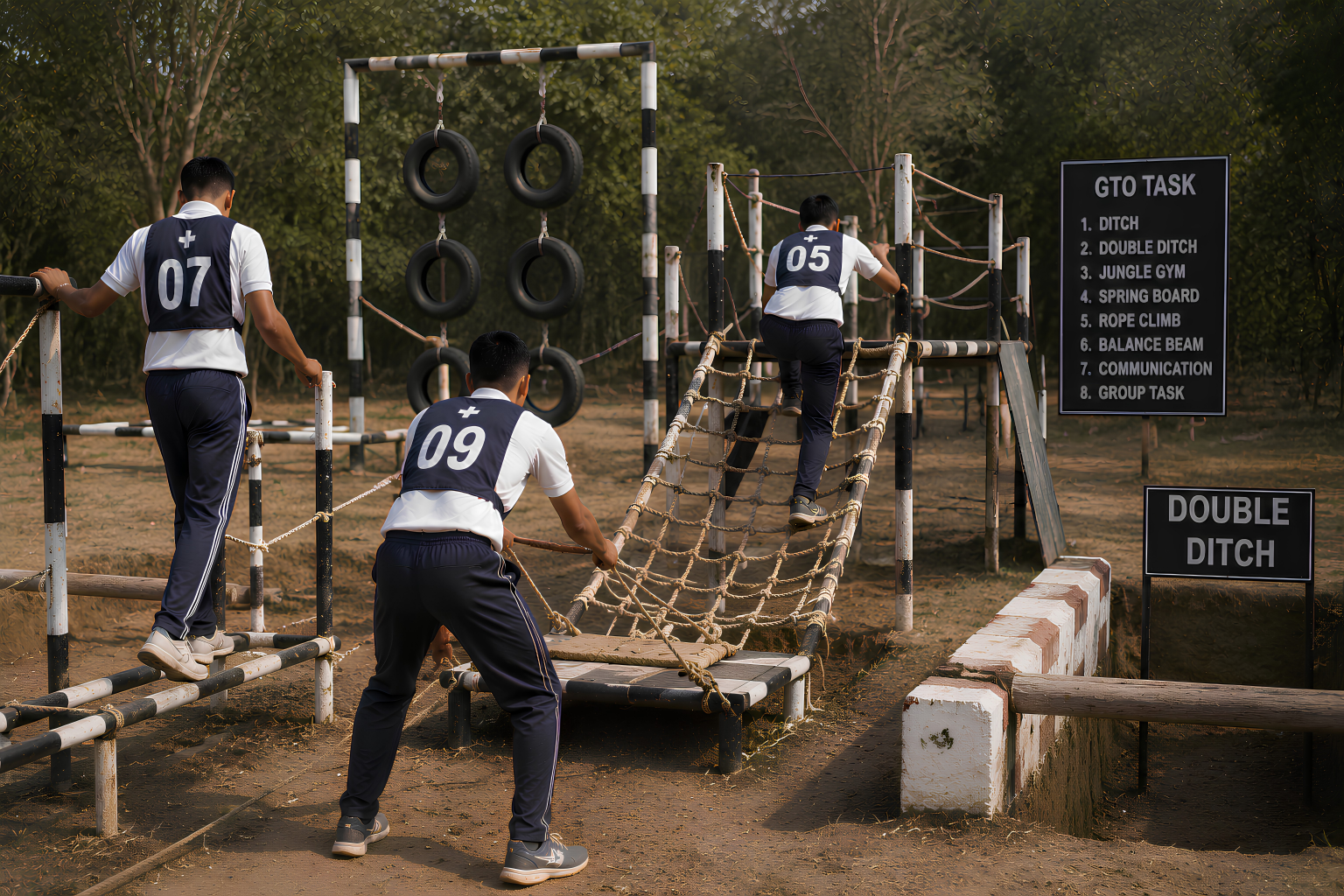
Progressive Group Tasks (PGT) constitute the initial set of outdoor obstacles. Groups are assigned a series of increasingly complex physical challenges, such as crossing obstacles using limited materials like planks, ropes, & barrels, while adhering to specific restrictions. A designated load must be transported throughout the tasks within a set time limit. Assessors observe leadership, problem-solving contributions, physical assistance to teammates, & performance under the combined pressures of task completion & group dynamics.
Half Group Tasks (HGT) replicate the outdoor obstacle format with smaller groups, enabling the GTO to more clearly assess individual contributions.
Day Four — Group Testing, Part Two & Personal Interview
Day Four is regarded as the most physically & mentally demanding phase of the selection process.
The Individual Obstacles (IO) course comprises ten obstacles of escalating difficulty, each assigned a specific point value. Candidates complete these tasks individually & within a set time limit. This phase assesses physical abilities such as balance, strength, agility, & the willingness to attempt challenging obstacles rather than opting for less demanding ones.
The Command Task provides a direct assessment of leadership capabilities. Each candidate is designated as a commander & selects two or three peers to assist in completing an obstacle. The candidate is responsible for planning the approach & directing the team. Assessors observe briefing skills, delegation, adaptability to changing circumstances, & interpersonal leadership skills.
The Final Group Task (FGT) reunites the entire group for a concluding outdoor obstacle exercise. This provides the GTO with a final opportunity to observe group dynamics & confirm or adjust previous assessments.
The Personal Interview (PI) is conducted by the Interviewing Officer, typically a senior military official. This one-on-one session, lasting between thirty minutes & over an hour, explores the candidate’s background, family, education, hobbies, strengths & weaknesses, current affairs knowledge, & motivation for joining the Armed Forces. The Interviewing Officer reviews the Personal Information Questionnaire completed on Day One, probes for inconsistencies, assesses self-awareness, & evaluates alignment with the psychologist’s & GTO’s observations.
Day Five — Conference
The final day is both the briefest & the most anticipated segment of the selection process.
The Conference convenes all three assessors—the psychologist, the GTO, & the IO—along with the Board President. Each candidate is briefly interviewed by the board & may be asked one or two questions. This stage serves as a final review, allowing assessors to raise observations or seek clarification on specific points.
Following each conference, the assessors deliberate collectively. The SSB uses a consensus-based system, requiring unanimous agreement among all three assessors before a candidate is recommended. This standard contributes to the low recommendation rate & ensures that selected candidates are endorsed with genuine confidence. Results are announced on the same afternoon. Recommended candidates advance to the medical examination phase, while others are released with the option to reapply later.
What the SSB Is Really Looking For?
The five-day selection process does not seek perfection, nor does it prioritise the most outspoken or physically adept candidates. Instead, it emphasises consistency, favouring individuals whose intelligence, personality, & character remain stable across all situations, tasks, & interactions throughout the assessment period. Recommended candidates are typically those who demonstrate genuine self-awareness, natural leadership, personal authenticity, & a composed confidence rooted in clear values & self-understanding. Preparation should focus on cultivating self-awareness & authenticity rather than on emulating others.