

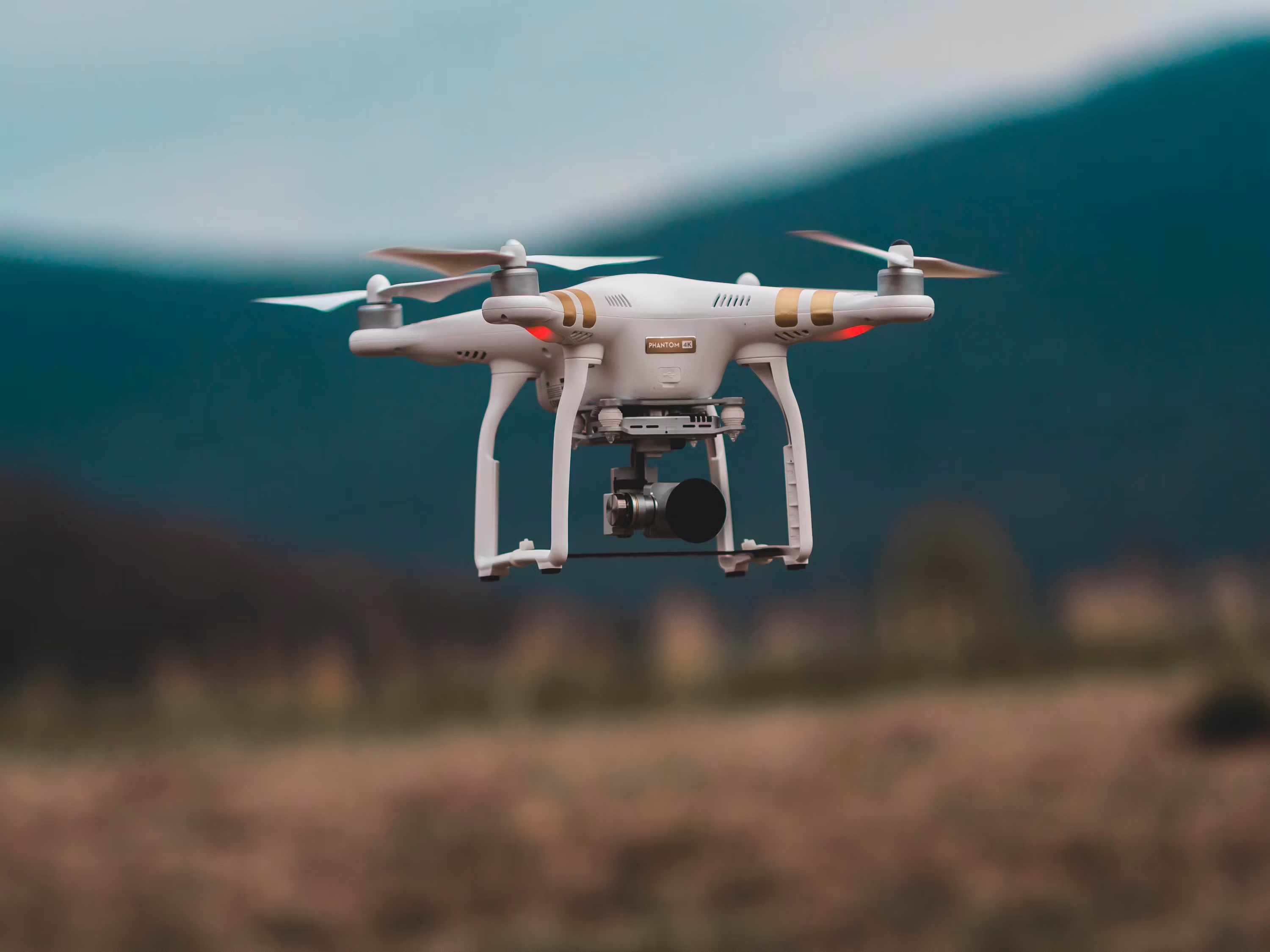
The current era is defined by drones: the most democratised, underestimated, & rapidly evolving security threat today, thanks to their low cost, accessibility, & adaptability, which have shifted the threat landscape. Drones often weigh less than a kilogram & cost less than a smartphone, yet can incapacitate billion-dollar facilities.
From Toy to Weapon: The Unanticipated Transformation
The first unmanned aerial vehicle was introduced in 1935 as a repurposed De Havilland biplane, the “Queen Bee,” utilised by the British military for artillery training. For several decades thereafter, drones remained exclusive to advanced militaries, characterised by high cost, complexity, & inaccessibility to the general public. This exclusivity has now ended. Currently, drones with multi-kilogram payload capacity, 10-kilometre range, 4K cameras, GPS navigation, & obstacle avoidance are commercially available for the cost of a mid-range laptop. These devices typically require neither a license nor formal training to purchase, making the threat widely accessible.
What Exactly Is a Drone?
A drone, technically referred to as an Unmanned Aerial Vehicle (UAV), is a flying robot capable of autonomous operation via software-controlled flight plans, utilising onboard sensors & GPS. Drones are broadly classified by weight, ranging from Nano (under 250 grams) to Large (over 150 kilograms). The primary threat to civilian & corporate environments arises from the nano, micro, & small categories because they are affordable, commercially available, difficult to detect, & easy to weaponise. Modern commercial drones operate on standard radio frequencies between 433 MHz & 5.8 GHz. Communication methods include direct radio links, WiFi, 4G/5G networks, & satellite connections. The most advanced models are fully autonomous & require no human operator after launch.
The Threat Is Not Hypothetical — It Is Documented
The global record of drone attacks & intrusions confirms that this threat is already active & growing, presenting significant concerns for security professionals. In September 2019, ten drones attacked Saudi Aramco’s oil processing facilities at Abqaiq & Khurais. Saudi Arabia’s Patriot missile defence system failed to intercept the swarm. The attack temporarily knocked out nearly half of Saudi Arabia’s oil production capacity. In January 2018, Syrian rebel groups launched 13 drones simultaneously against Russia’s Khmeimim airbase. Seven military aircraft were destroyed & two soldiers killed before the attack was contained. In June 2021, the Indian Air Force station at Jammu was attacked by two commercially procured drones carrying improvised explosive devices, marking the first documented drone attack on an Indian military installation. In 2024, federal authorities in the United States prevented an attempt to bomb a power substation in Nashville using a drone equipped with C-4 explosives. In the same year, a Chinese national employed a drone to photograph nuclear submarines under assembly in the United States, underscoring the role of drones in strategic espionage.
Drones as Weapons
Surveillance & Espionage: High-resolution cameras & thermal imaging sensors enable drones to map facilities, monitor movement patterns, & identify security vulnerabilities. Drones have been utilised to surveil individuals, observe through open windows, & collect real-time intelligence on sensitive operations.
Payload Delivery: Micro & small drones are capable of transporting improvised explosive devices, grenades, or contraband. Incidents such as the Jammu & Saudi Aramco attacks demonstrate the operational reality of this threat.
Cyber Attacks: Drones can deploy network sniffers, spoof Wi-Fi signals, & introduce rogue access points, thereby facilitating cyber intrusions into facilities that would otherwise require physical proximity.
Swarm Attacks: Multiple drones can attack simultaneously from various directions, overwhelming detection & response systems. Security experts anticipate that drone swarms will become a standard & a critical threat vector, necessitating the development of new countermeasures.
Countering Drone
Anti-drone technologies types:
Detection Technology: This includes RF scanners, radar systems, electro-optical cameras, thermal imaging, acoustic sensors, & AI-powered sensor fusion platforms.
Soft Kill Systems: RF jammers, GPS jammers, & spoofing systems are used to disable drones without physical destruction. These methods are preferred in civilian environments where collateral damage is unacceptable.
Hard Kill Systems: Laser systems, net-firing weapons, conventional anti-aircraft systems, & interceptor drones are employed to physically destroy or capture the threat.
Hybrid Systems: These are integrated platforms that combine detection, tracking, & neutralisation capabilities within a single system.
The Regulatory Gap
Legal challenges represent a significant barrier. Even advanced militaries & law enforcement agencies face difficulties in reliably countering drones, while private companies are generally unable to address drone threats legally without government authorisation. In most jurisdictions, jamming radio frequencies, which is the most effective soft-kill method, is prohibited for private entities. This situation creates a significant gap: the threat is real, the technology is available, yet the legal framework remains inadequate.
Conclusion
Most security teams focus on two-dimensional protection, such as fences, gates & walls — but drones introduce a third dimension that organisations must factor into both their physical & cybersecurity plans, because the threat now extends above the perimeter. The sky is no longer neutral ground. It is a contested space — & organisations that fail to recognise this will be the most vulnerable targets of the decade ahead. The conclusion is clear: drone risk is now a permanent security concern, not a peripheral one.