

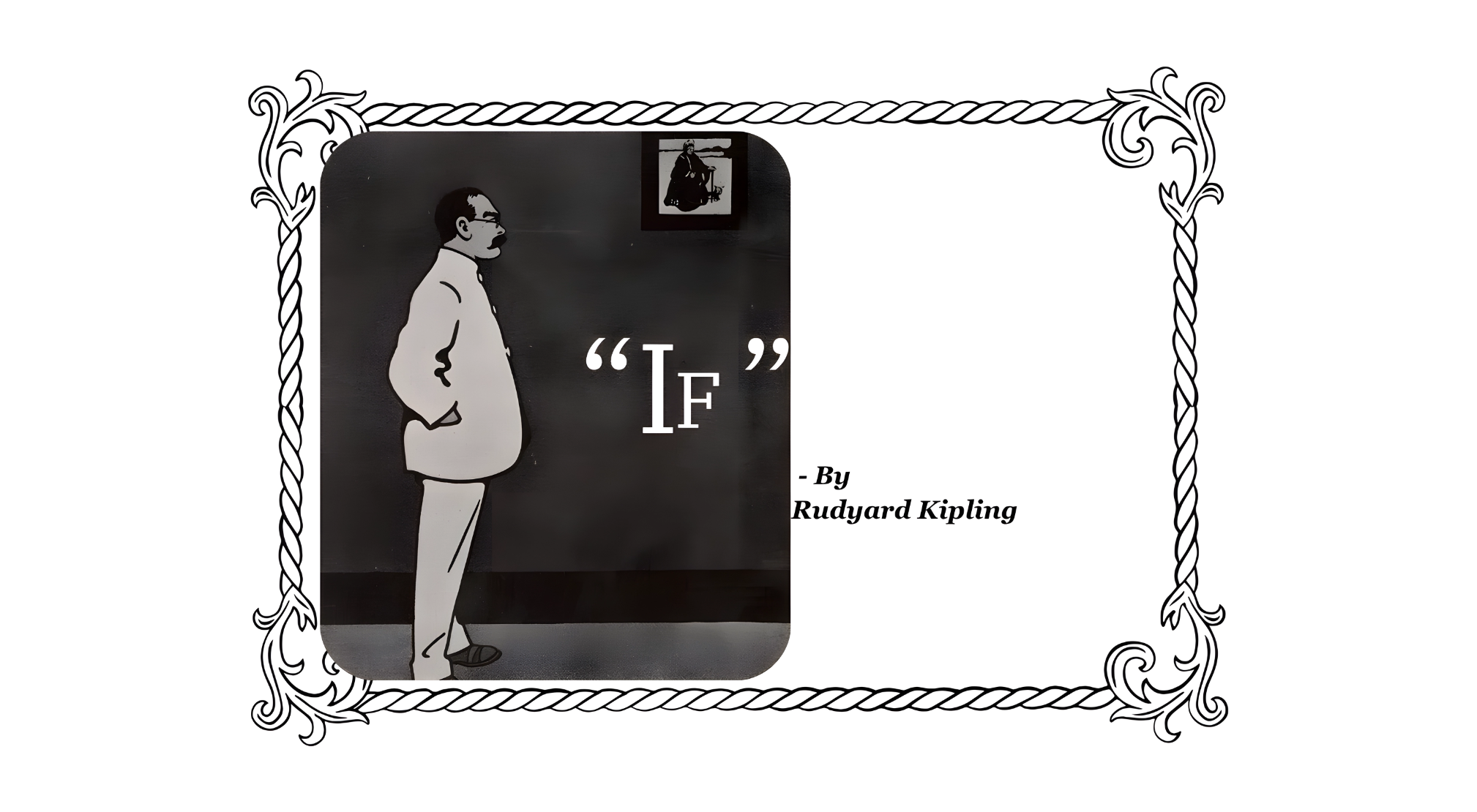
IF — Rudyard Kipling, 1910
If you can keep your head when all about you
Are losing theirs and blaming it on you,
If you can trust yourself when all men doubt you,
But make allowance for their doubting too;
If you can wait and not be tired by waiting,
Or being lied about, don't deal in lies,
Or being hated, don't give way to hating,
And yet don't look too good, nor talk too wise:
If you can dream—and not make dreams your master;
If you can think—and not make thoughts your aim;
If you can meet with Triumph and Disaster
And treat those two impostors just the same;
If you can bear to hear the truth you've spoken
Twisted by knaves to make a trap for fools,
Or watch the things you gave your life to, broken,
And stoop and build 'em up with worn-out tools:
If you can make one heap of all your winnings
And risk it on one turn of pitch-and-toss,
And lose, and start again at your beginnings
And never breathe a word about your loss;
If you can force your heart and nerve and sinew
To serve your turn long after they are gone,
And so hold on when there is nothing in you
Except the Will which says to them: 'Hold on!'
If you can talk with crowds and keep your virtue,
Or walk with Kings—nor lose the common touch,
If neither foes nor loving friends can hurt you,
If all men count with you, but none too much;
If you can fill the unforgiving minute
With sixty seconds' worth of distance run,
Yours is the Earth and everything that's in it,
And—which is more—you'll be a Man, my son!
Rudyard Kipling wrote “If—” around 1895, inspired by Leander Starr Jameson, who faced public disgrace after a failed military raid with extraordinary composure. Published in 1910, the poem has since been translated into 27 languages & voted Britain’s favourite poem by the BBC. Kipling, a Nobel Laureate born in Bombay, India, understood both Eastern resilience & Western discipline. That rare combination breathes through every line of the poem. At its core, “If—” is a father’s advice to his son. But it transcends that relationship entirely. It is a blueprint: 32 lines defining what an extraordinary human being looks like under pressure, under failure, under temptation, & under success. The entire poem is architecturally brilliant: one single conditional sentence across four stanzas, withholding its reward until the very last two lines. Just like life itself.
Stanza One establishes the foundation: Composure, self-belief, honesty, & humility. Keep your head when everyone around you is losing theirs. Trust yourself when all men doubt you, but stay humble enough to consider why they doubt. Don’t perform virtue. Live it.
Stanza Two raises the challenge further. Kipling calls both Triumph & Disaster “impostors”—because neither is permanent & neither should define you. The real test is when everything you built gets destroyed. His answer? Stoop. Pick up worn-out tools. Build again. No complaints. No self-pity.
Stanza Three is about pure will. Risk everything. Lose everything. Start again from nothing & never breathe a word about your loss. When your body is spent, & your heart has nothing left, Kipling asks for one final thing: the will that simply says, “Hold on,” with grace. After composure, setback, & endurance, Kipling turns to character in the world. Walk with kings, but never lose the common touch. Let neither enemies nor friends have power over your inner world. Finally—fill every minute with purpose. Not someday. Every minute. The reward for all of this? “Yours is the Earth & everything that’s in it.” & then, the line that hits hardest: “And — which is more — you’ll be a Man, my son.” The Earth is secondary. The greater prize is the person you become.
What makes “If—” immortal is not its language, though the language is magnificent. It is that Kipling asks nothing superhuman. He asks for steadiness, not perfection; humility, not weakness; courage, not recklessness. These are qualities every human being can aspire to & almost none fully achieve.
That gap between aspiration & achievement is precisely where the poem lives, & why, more than a century later, it still speaks directly to anyone who reads it—soldier or student, leader or beginner.