

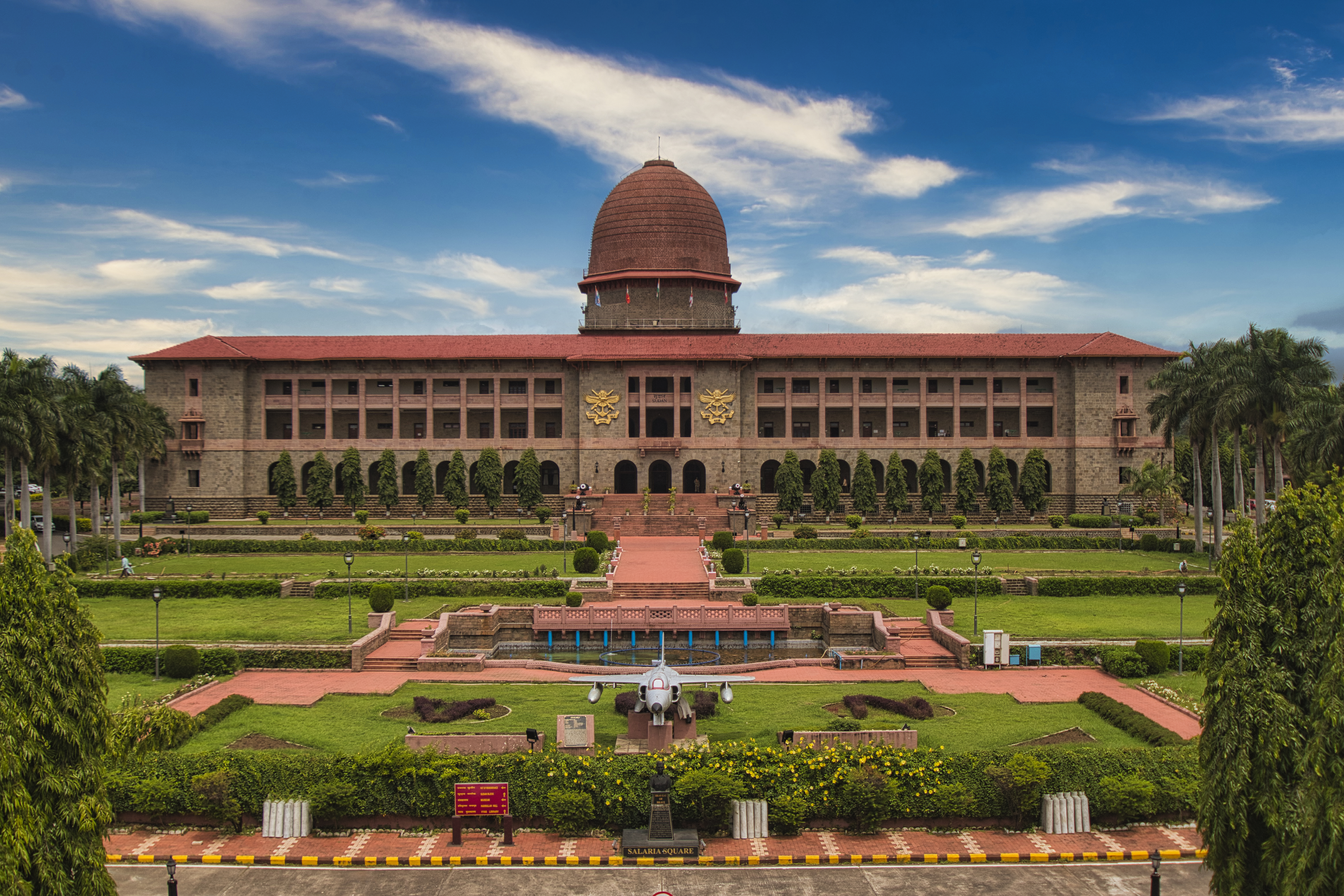
Some institutions educate, & others transform. The National Defence Academy, Khadakwasla, belongs firmly to the second category. Nestled in the folds of the Sahyadri ranges, with the ancient Sinhagad Fort standing sentinel on the horizon & the still waters of Khadakwasla Lake reflecting the morning sky, the NDA is not merely a military academy. It is where boys & girls arrive, & officers emerge. It is where India’s finest are tested, tempered, & ultimately — trusted with the nation’s shield.
The Seed of an Idea — Born in the Fires of War
The story of the NDA does not begin in Pune. It begins on the battlefields of World War II. As Indian soldiers fought & bled alongside Allied forces across continents — from North Africa to Southeast Asia — a quiet but powerful realisation was taking shape in the minds of India’s military leadership. The Army, the Navy, & the Air Force operated in silos. Coordination between the services was an afterthought. If India were to build a truly formidable defence force after independence, that had to change — fundamentally & permanently.
At the close of World War II, Field Marshal Claude Auchinleck, then Commander-in-Chief of the Indian Army, led a committee that studied military academies worldwide & submitted its recommendations to the Government of India in December 1946. The committee called for the creation of a Joint Services Military Academy, drawing inspiration from the United States Military Academy at West Point. The vision was bold & unprecedented — one institution, three services, one unified fighting spirit.
The Interim Beginning — Dehradun, 1949
Independence arrived in August 1947. Within months, the Chiefs of Staff Committee moved swiftly to implement the recommendations of the Auchinleck report. While the search for a permanent site was underway, an interim training academy — the Joint Services Wing (JSW) — was commissioned on 1 January 1949 at the Armed Forces Academy in Dehradun. It was a beginning, not a destination.
The name of that location carried its own weight. Dehradun traces its etymology to “Dera-Drona” — the Camp of Drona, the legendary preceptor of warriors in the Mahabharata. That the first seeds of India’s premier military academy were sown in the Camp of Drona was less coincidence, more destiny.
Khadakwasla — Chosen for a Reason
While cadets trained in Dehradun, a parallel exercise was underway — finding a home worthy of what this institution was meant to become. Several sites were considered: Bombay, Bangalore, Deolali, Vizag, Secunderabad, & others. Each had its advocates. However, Khadakwasla, on the northwest banks of its namesake lake, made a compelling case that the others could not match. The site was chosen for its proximity to the Arabian Sea, a nearby operational air base at Lohagaon, a salubrious climate ideal for rigorous training, & the existence of an old combined-forces training centre along with a disused mock landing ship — HMS Angostura — on the north bank of the lake, which had once been used to train troops for amphibious operations.
Nature itself seemed to conspire in Khadakwasla’s favour. The Sahyadri ranges provided the terrain. The lake provided the water. Moreover, the brooding Sinhagad Fort on the ridge above provided something no other site could — a constant, silent reminder of what it means to defend one’s land to the last breath. On 6 October 1949, Prime Minister Jawaharlal Nehru himself laid the foundation stone of the academy at Khadakwasla. The nation’s first Prime Minister understood the weight of that moment — he was laying the cornerstone of India’s military future.
Operation Badli — The Great Move
The relocation from Dehradun to Khadakwasla was not a simple administrative exercise. It was a carefully orchestrated military operation, fittingly codenamed “Operation Badli.” In December 1954, the academy made its landmark move from the historic Camp of Drona in Dehradun to its permanent home in Khadakwasla. This transition marked a defining milestone in the institution’s history.
The academy was formally commissioned on 7 December 1954 & inaugurated on 16 January 1955 by Morarji Desai, then Chief Minister of Bombay State. The Joint Services Wing programme was formally transferred to the NDA, & a new chapter in Indian military history was written.
The Sudan Block — A Memorial in Stone
Among the many iconic structures on campus, one stands apart in both symbolism & story — the Sudan Block, the administrative headquarters of the NDA. During World War II, Indian troops played a pivotal role in the liberation of Sudan. In recognition of that sacrifice, the Sudanese Government gifted one hundred thousand pounds to the Governor General of India. After Partition, India’s share amounted to seventy thousand pounds. The Indian Army partly financed the construction of the NDA with these funds.
The Sudan Block, therefore, is not just a building. It is a monument to blood spilt on foreign soil for a cause larger than self. Every cadet who walks through its corridors walks through history.
A Campus Like No Other
The NDA occupies a canvas that would humble most universities worldwide. Spread across 7,015 acres of land donated by the Government of former Bombay State, the campus sits approximately 17 km southwest of Pune city, with the Sinhagad Fort providing a dramatic panoramic backdrop.
The architecture itself tells a story of tri-service unity. The Sudan Block evokes the Army’s strength. The Naval Training complex is shaped to resemble an anchor. Moreover, Habibullah Hall, viewed from above, takes the form of an aircraft — as though the campus itself has taken wing. The infrastructure is built to stretch every cadet to his limit — two Olympic-size swimming pools, 32 football fields, a cricket stadium, polo grounds, a gymnasium, & courts for squash & tennis. This is not a luxury but a deliberate architecture of excellence.
The First in the World — & Still Unmatched
Here is a fact that every Indian should know & every defence aspirant should carry with pride:
The NDA is the world’s first tri-service military academy.
Cadets of the Indian Army, the Indian Navy, & the Indian Air Force train together at the NDA before proceeding to their respective service academies for pre-commissioning training. No other nation had conceived of — let alone executed — such an integrated model of military education before India did.
This joint training is not incidental. It is foundational. The officer who has sweated alongside a Naval cadet on an obstacle course & competed with an Air Force cadet in the debating hall carries a different understanding of jointmanship into his service career. That understanding, accumulated across generations, has made the Indian Armed Forces one of the most professionally coordinated defence forces in the world.
The Legacy — In Numbers & in Blood
The NDA’s true measure is not in acres or infrastructure. The officers have produced it. The NDA alums include three Param Vir Chakra recipients — India’s highest wartime gallantry award — & 13 Ashoka Chakra recipients. The academy has produced 32 Service Chiefs of Staff. In 2019, in a moment that spoke volumes about the NDA’s dominance of India’s military leadership, all three Chiefs of Staff — Army, Navy, & Air Force — were NDA alumni from the same 61st course.
Beyond the battlefield, NDA alums have scaled the world’s highest peaks, ventured into space, led diplomatic missions, & made their mark in civil society. The academy does not merely produce warriors — it produces leaders for all seasons.
Women at the NDA — A Historic First
For decades, the NDA was an exclusively male institution. That changed in a manner that made history. In August 2022, women cadets joined the NDA for the first time as part of the 148th course — a moment that redefined the institution & signalled a new era for women in India’s Armed Forces. The NDA, always at the forefront, embraced this change not as a disruption but as an evolution.
The Honour Code — The Soul of the Academy
Uniforms can be worn. Ranks can be earned. However, the Honour Code is something that must be lived. Every cadet at the NDA is bound by a commitment that transcends regulation:
“I believe that a cadet must be loyal, truthful, trustworthy, honest, & forthright under all circumstances.”
Simple words. Immeasurable weight. These are not merely the values of a cadet — they are the foundation of every officer the NDA sends out into the world.
Seva Paramo Dharmaḥ — Service Before Self
The motto of the National Defence Academy is not a slogan. It is a way of life.
Seva Paramo Dharmaḥ — Service Before Self.
It is the quiet truth that underlies every gruelling PT session before dawn, every night exercise in the hills, every moment a cadet chooses duty over comfort. It is the creed that has guided NDA alums through wars, through peace, through sacrifice — & that continues to guide those who pass through Khadakwasla’s gates today.
Closing Thought
The National Defence Academy is more than an institution. It is India’s promise to itself that it will always have officers worthy of the uniform, worthy of command, & worthy of the trust of 1.4 billion people. For every young person who dreams of wearing olive green, navy white, or air force blue, Khadakwasla is not just a destination. It is a calling. Moreover, the Sinhagad Fort watches over it all, as it always has — silent, steadfast, eternal.